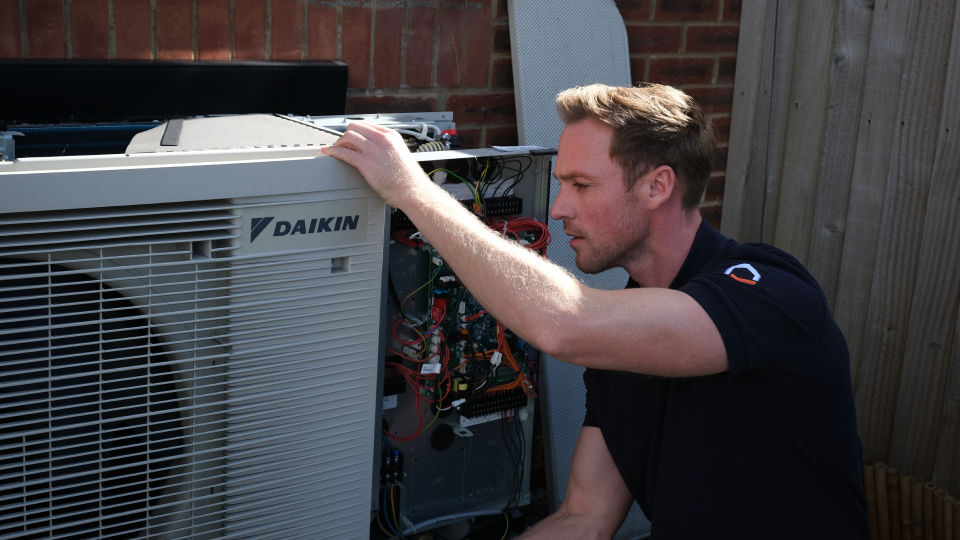



When you think of an air heat pump service, you might assume it’s going to be quite quick and straight-forward.
However, this isn’t quite the case. In reality, air source heat pump servicing is more like a car service. There are lots of different pieces that a professional needs to check and it’s essentially a deep dive into thermodynamic, electrical safety and hydraulic balance.
The big difference between a gas boiler service and an air source heat pump service is that gas services focus on combustion safety and gas pressures. In contrast an ASHP service is focused on efficiency and heat transfer.
If a heat pump isn’t serviced, it won’t blow up or be a safety hazard, but it could cause energy bills to soar because the system will struggle to remain efficient.
On average a full service by a qualified engineer will take anywhere between 60 and 90 minutes. Let’s look at what a professional will do in this time period.
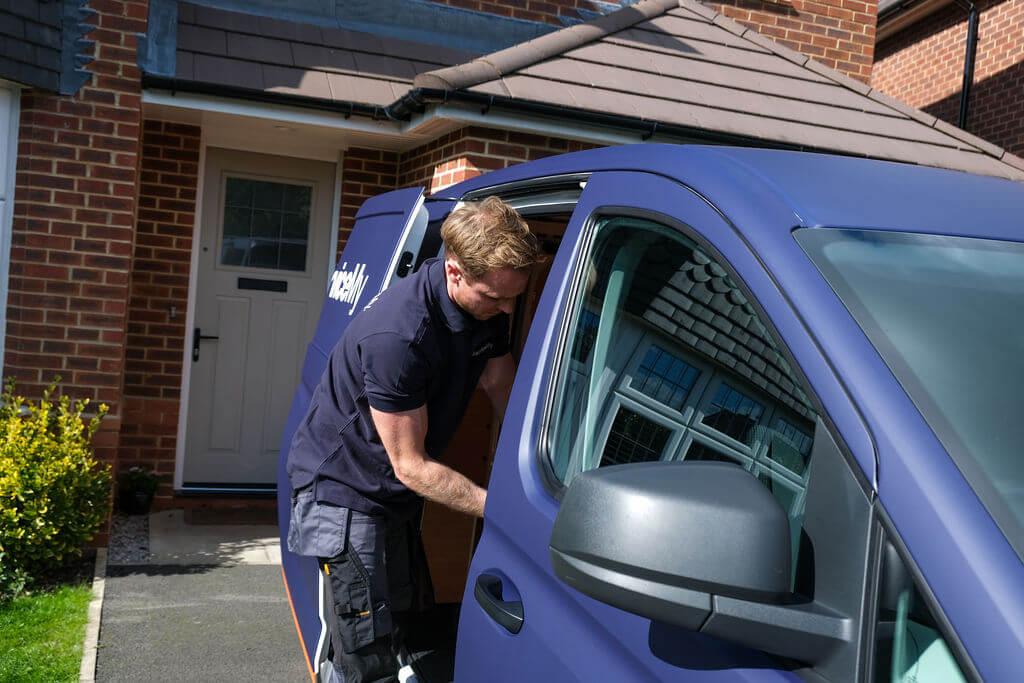
The Visual & Physical Inspection
Before they even open the unit an engineer will complete a “walk around” check and explore the physical environment. They will check that there aren’t any new fences, sheds or similar additions close to the unit.
An ASHP needs a huge amount of fresh air. If the air hits a wall and bounces back into the intake the unit will short-circuit.
Heat pumps are also quite heavy and even vibrate. If the concrete plinth has shifted or sunk, it will put stress on the refrigerant pipes and cause a massive leak.
The engineer will also check for signs of oil stains which indicate issues with corrosion.
Cleaning The Evaporator
The next step is to clean the evaporator and this is arguably the most crucial part of the service. This is the large radiator on the back of the unit. Its job is to absorb all the heat from the surrounding air.
During a service, debris will be removed from the filter. This could include pollen, dust, leaves, and spider webs.
The engineer will use a soft-brist brush as well as a coil cleaner spray to remove any build up of grime. They need to be careful here because the aluminium fines are paper thin and easy to bend.
If this happens, they will restrict air-flow and the fan will need more power to keep the compressor running smoothly.
The Refrigerant Circuit & Leak Testing
The refrigerant is a key part of the system. It’s usually sealed inside the unit but the engineer will need to make sure that this seal is intact during the service.
They will use an electronic leak detector to check the joints and valves of the system. They will also check the superheat and subcooling temperatures.
This will let them know whether the refrigerant charge is at the right level. If it’s too low, the system could still deliver heat but at a much lower performance overall.
Electrical and Component Testing
Inside the unit there are complex PB boards as well as high-voltage capacitors and the inverter drive.
Since the unit lives outside and vibrates overtime, it’s common for electrical connections to shake loose. Loose wires will cause resistance which leads to a board failure. So, an engineer will check for this issue.
During air source heat pump service, the engineer will also use a multimeter and check the resistance of the sensors. If the sensors are drifting, it means it thinks that the water is a different temperature than it is in reality. This can cause issues with efficiency.
Finally, an engineer will also check the fan bearings for any grinding noises. This is a telltale sign of a failure in the future.
Water Flow and Filtration
A heat pump will only work if the water is moving freely through your radiators. Since heat pumps operate at lower temperatures compared to boilers, they require a higher flow rate.
The majority of systems have a magnetic filter to catch sludge running through the system. An engineer will drain and clean this during heat pump services. If it’s blocked with sludge, the heat pump will rapidly switch on and off because it can’t get rid of the excess heat.
There’s also a pressure vessel which will handle the expansion of water when it heats up. The engineer will use a pump to “re-charge” the air pressure within the tank. This presents your system pressure from constantly shifting overtime.
Anti-Freeze Protection
A big difference between a boiler and a heat pump is that the latter has water pipes which are outside. As such, you need to prevent these from bursting during the cold months due to a powercut.
To do this, anti-freeze is added into the system. The engineer checks if this is working correctly during a service. They will take a small sample of the heating water and using a refractometer, they’ll check exactly what temperature the pipes are protected up to – or down to.
The thing about the anti-freeze is that it can become acidic over time. That’s why the engineer will also test the pH level to guarantee fluid isn’t corroding the inside of the radiators.
Performance Benchmarking
Last, but certainly not least, the engineer will turn on the system and let it run for 15 to 20 minutes at a steady rate.
They will use this time to measure the temperature of the water going around the radiators compared to the water coming back. They’ll be checking for a drop of up to 5 degrees.
They will also explore the “weather compensation” curve. If they notice that water at 50 degrees is going out to radiators when it is 10 degrees outside, they’ll turn this down to save you money and provide a more efficient solution overall. Lower flow temperatures makes the heat pump more cost-friendly.
Learn More
There you have it, everything that you can expect to happen during your annual air source heat pump service. If you have any more questions or would like to arrange a service for your system, please don’t hesitate to get in touch today. A friendly member of our team will be happy to assist you further.